Hong Kong-Bound Food Labelling Guide (Part 3): Essential Compliance for Nutrition Claims — "Low Fat" and "Sugar-Free" Cannot Be Written Casually
2026-11-10 to 2026-11-11A biscuit wants to highlight its health selling point, so "Low Fat" is printed on the front of the packaging; a beverage wants to attract consumers focused on sugar control, so "Sugar-Free" is printed on it. These seemingly common packaging promotional phrases cannot be used casually in the Hong Kong market.
If a nutrition claim does not comply with Hong Kong's regulatory requirements, a product that has been carefully prepared may still face trouble such as label rectification and repackaging.
So, what exactly are Hong Kong's specific requirements for nutrition claims? This article will combine Hong Kong's current regulations to interpret the specific requirements for nutrition claims one by one, helping manufacturers identify easily overlooked compliance issues in advance.
Examples of nutrition claims:
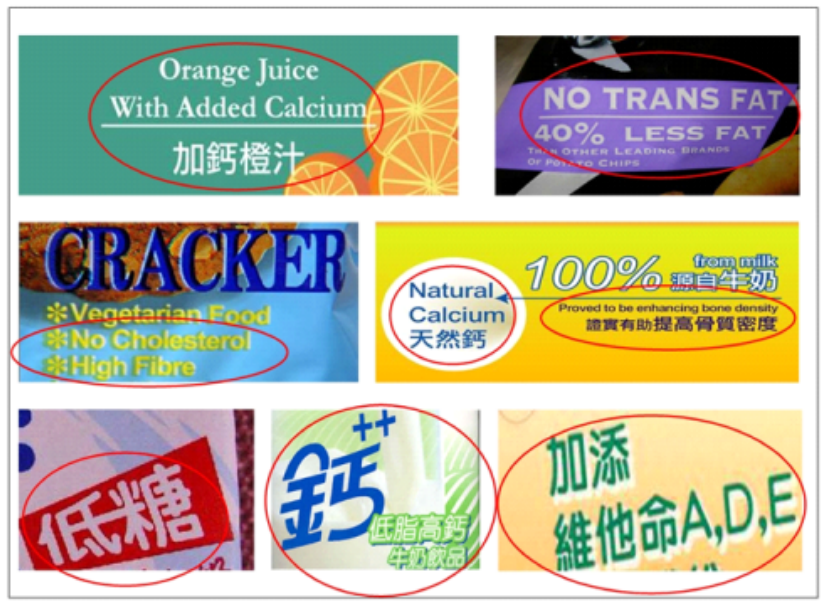
01 Definition of Nutrition Claims
A nutrition claim means any statement which states, suggests or implies that a food has particular nutritional properties, covering the level of energy, core nutrients, and vitamins and minerals.
It is specifically divided into three categories:
① Nutrient content claims, e.g., "low fat", "no sugar", "high calcium";
② Nutrient comparative claims, e.g., "30% less sugar than the regular version"; "lower", "30% less sugar";
③ Nutrient function claims, e.g., "calcium helps build healthy bones".
Three scope issues that are often overlooked:
First, claims do not only look at packaging labels; promotional materials are equally regulated — advertising, flyers, web images and other promotional content must also be rigorous.
Second, not claiming "low sugar", but writing "lightly sweet experience" and pairing it with a large number "0", will also be recognised as a claim.
Third, content claims can only be made for specified nutrients. Nutrients not in Schedule 8 (such as collagen) have no content claim thresholds, so there is no compliant way to write "low XX" or "no XX".
02 Content Claims: Principles and Quantitative Thresholds
Nutrient content claims need to meet four conditions:
The nutrient is within the scope of Schedule 8 or Schedule 7, the content meets the claim threshold, there is scientific evidence and scientific consensus, and no disease claims are made. (For details, see the link on Nutrition Labelling and Nutrition Claims)
The following are the conditions for nutrition claims in the Food and Drugs (Composition and Labelling) Regulations:
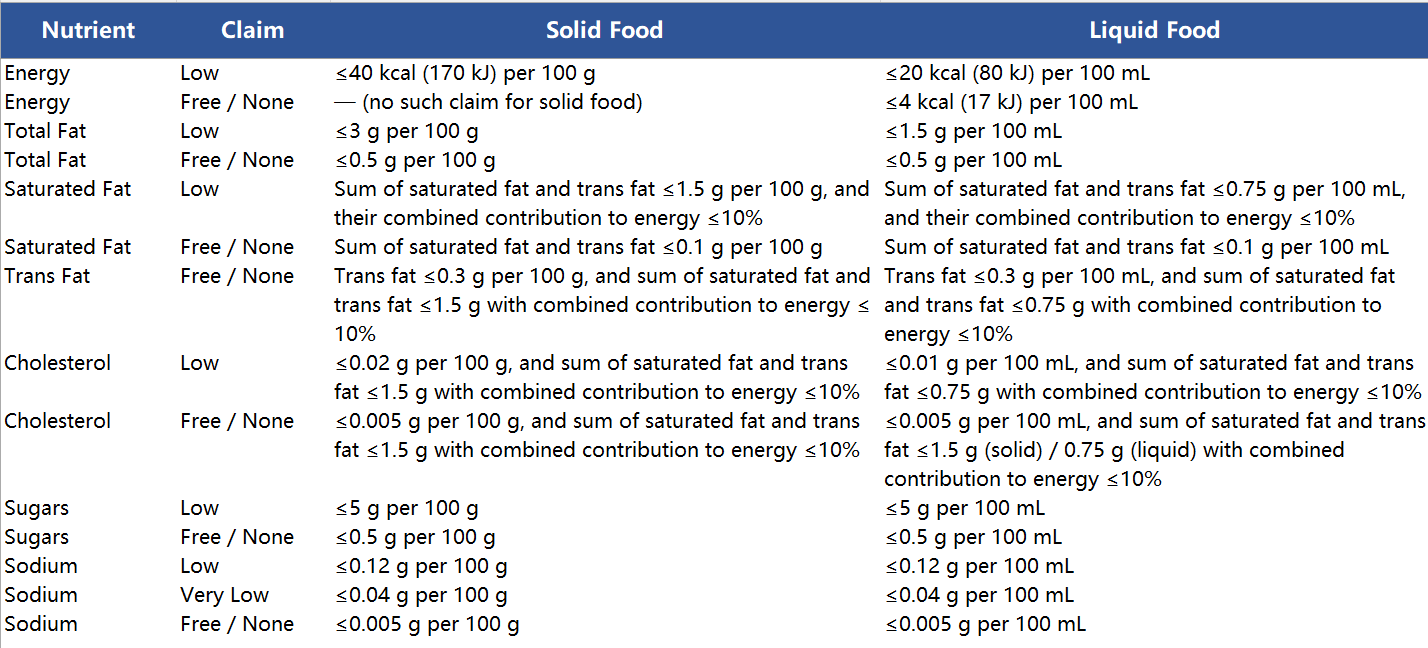

Among them, only when the "source" threshold is met can positive expressions such as "contains protein", "provides protein", or "source of protein" be used.
Please note: If the packaging says "no trans fat", the following three requirements must be met simultaneously:
① Trans fat itself ≤ 0.3g/100g;
② Saturated fat + trans fat combined ≤ 1.5g/100g;
③ Energy provided by these two fats ≤ 10% of total food energy.
However, to label trans fat as "0" on the nutrition label, only a content of ≤ 0.3g is required; if the front of the packaging promotes "no" trans fat, then the above three requirements must be met.
03 Linkage Rules
① The nutrients involved in the claim must have their absolute content declared — if you write "high fibre", dietary fibre must be included in the nutrition label list; if you write "high calcium", the calcium content must be declared item by item;
② When the claim involves fat, the label must also declare cholesterol — even if it only says "low fat", cholesterol content must also be declared;
③ For the 16 categories of products eligible for exemption from nutrition labelling (such as those with annual sales ≤ 30,000 units), as long as any nutrition claim appears on the packaging or promotional materials, the exemption becomes invalid, and all nutrition labels must be completed.
04: Expressions That Do Not Count as Nutrition Claims
The regulations expressly list six situations that are not regarded as nutrition claims:
Nutrients mentioned in the ingredient list;
"Gluten-free", "lactose-free" and similar expressions;
Quantitative or qualitative declarations required by law;
Declarations that genetic modification has altered nutritional value;
Expressions forming part of a food name/brand/trademark;
And quantitative declarations that do not emphasise high or low — such as "contains 650mg Omega-3 per serving".
The technical guidance FAQs also point out that "less sweet", "no added sweeteners", "no MSG", "no caffeine", "contains electrolytes" and glycaemic index (GI) related claims are not nutrient content claims.
Note: "Less sweet" is not a nutrition claim because it is a sensory description. Second, these non-claim expressions must still be true and not misleading.
05 Synonym Claims
Claim synonyms are shown in the table below; similar expressions outside the table will also be treated as the relevant claims:
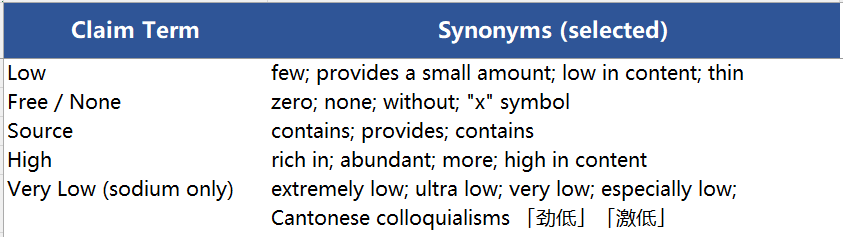
Note: "Very low" can only be used to describe sodium content; "very high" cannot be used to describe any nutrient;
Saying "how much is fat-free" using a percentage is also a content claim. Writing "1%~99% fat-free" is managed according to the "low fat" threshold, while writing "100% fat-free" or "0% fat" is managed according to the fat-free threshold.
"Skimmed milk" and "semi-skimmed milk" are not claim terms, but must comply with the compositional standards for milk.
Hong Kong's nutrition claim system differs considerably from that of the Mainland, so for Mainland manufacturers, it is not an obstacle but a test — manufacturers who master this set of rules first can get their products onto the shelves one step faster.